

"Fragments"
A short story contemplation

“Fragments”
A kind of short story contemplation
1
I heard the Word that drives the world. I did not understand it, though this was not the first time I had heard it.
Night before last, I heard the Word in a dream, but I forgot it when I awoke.
Yesterday, a dead man read the Word to me, but I forgot it last night while I slept.
Today, my father spoke the Word to me—or at least he spoke many words. I retained only a few fragments of what he told me, but those I do cherish.
2
The Word is common.
“Common sense is uncommon,” my father repeats—the cliché on the cliché. Yet he has always lived as if he had a wisdom all his own.
3
As a little boy, I asked my father, “Dad, just how big is the sun?”
He looked up from where we were watering the cows, adjusted his hat.
He covered the sun with his hand, moved the tobacco in his mouth. “As big as my hand,” he laughed.
4
I have always wondered what happiness really is. Life, liberty, and happiness—that’s what Jefferson would have me pursue. The old, dead man. And I pursue it. But can my life and liberty really be guaranteed me?
“I don’t even know that it should be, let alone is,” my father said.
“And happiness?” I asked him. “I know it isn’t all about pleasure, right? But then pleasure does seem to have something to do with it.”
My father didn’t answer, just pulled another bale of alfalfa hay from the bed of the truck. He took the wire cutters from his overalls, snipped both wires. We divided the hay into its squares and, together, we tossed them into the corral.
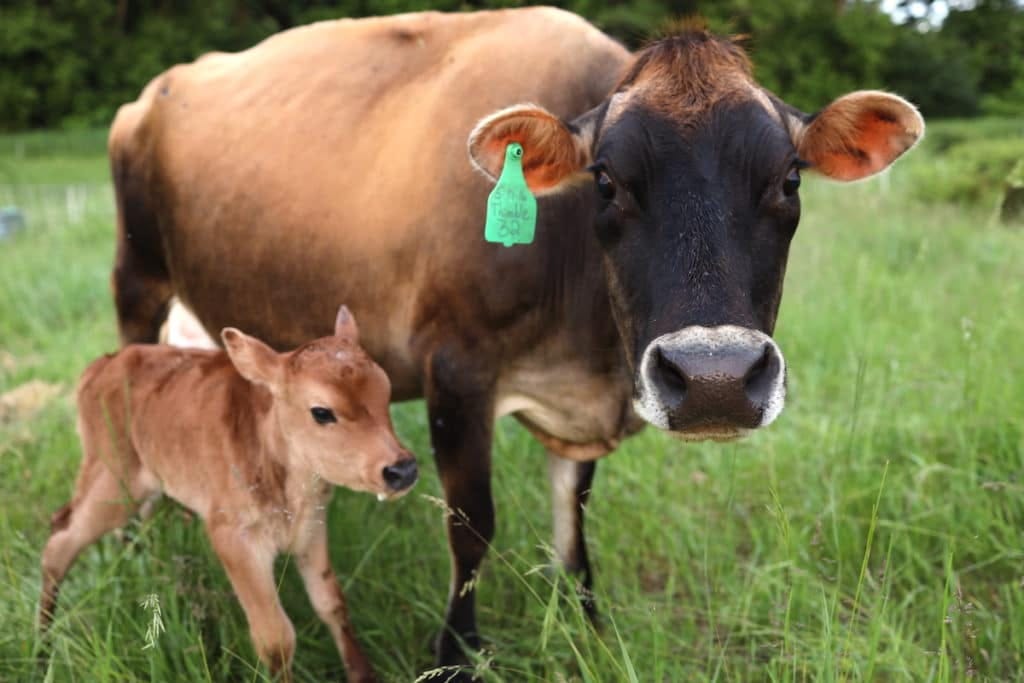
We called for our Jerseys. The cows came running, devoured the first few squares, then began to chew more slowly. Our newest mother called for her calf, to come and partake of the sweet alfalfa before it was gone, but the calf was several yards away, happily pulling bitter vines off an oak tree.
5
When we finished feeding the cows, we began to work back closer toward the house. My mother called us in for breakfast, and I rushed to the wash basin—but the water was dirty.
I dumped the water out into the mud and pumped new water into the basin. I washed the dirt off my hands and arms and face. Clean, I ran through the house to the breakfast table, and I bowed my head while my father blessed the meal. I prayed too, careful not to make God an object in the room but to let Him be God.
The prayer finished, I looked across the table at my father, my hero.
6
The fog rising up from frost-brittled grass, and descending to meet us from hovering clouds, obscures the morning sun until it shines like the moon.
I flip on my headlights and painfully squint through this dense mist rolling across the highway and lingering over the shoulder. And I wonder—Will every new dawn reoccur the same way?
7
My father and I got along fine—though we clashed often. We clash often still. We were both conflicted, are, but in different ways.
He was a practical and scientific man, against superstition but curious, yet also a preacher, a praying man, and he was a Bluegrass player.
I wanted to be logical, philosophical, wanted to be an engineer as well, yet I always felt the unreasonable and unproductive pull of poetry, the seduction of it, my addiction.
There was always a fire to my father. I appreciated that. But an anger too. I could smell it coming—the smoke. My sense of smell led the way—my perception—it taught me prudence.
Sometimes, the fire might even come if I asked too many questions. Even so, we teased each other, and we wrestled every day—both physically, out in the fields, laughing all the while, and mentally, spiritually—a joyful wrestling of opposites.
A true piece of fiction about my father, grandfather, brother, and me, written one morning after having read the fragments of Heraclitus.